System Architecture
This page describes how the MapSwipe system is put together: the old vs. new architecture, and the individual components that make up the new architecture today.
Architecture overview
Old architecture
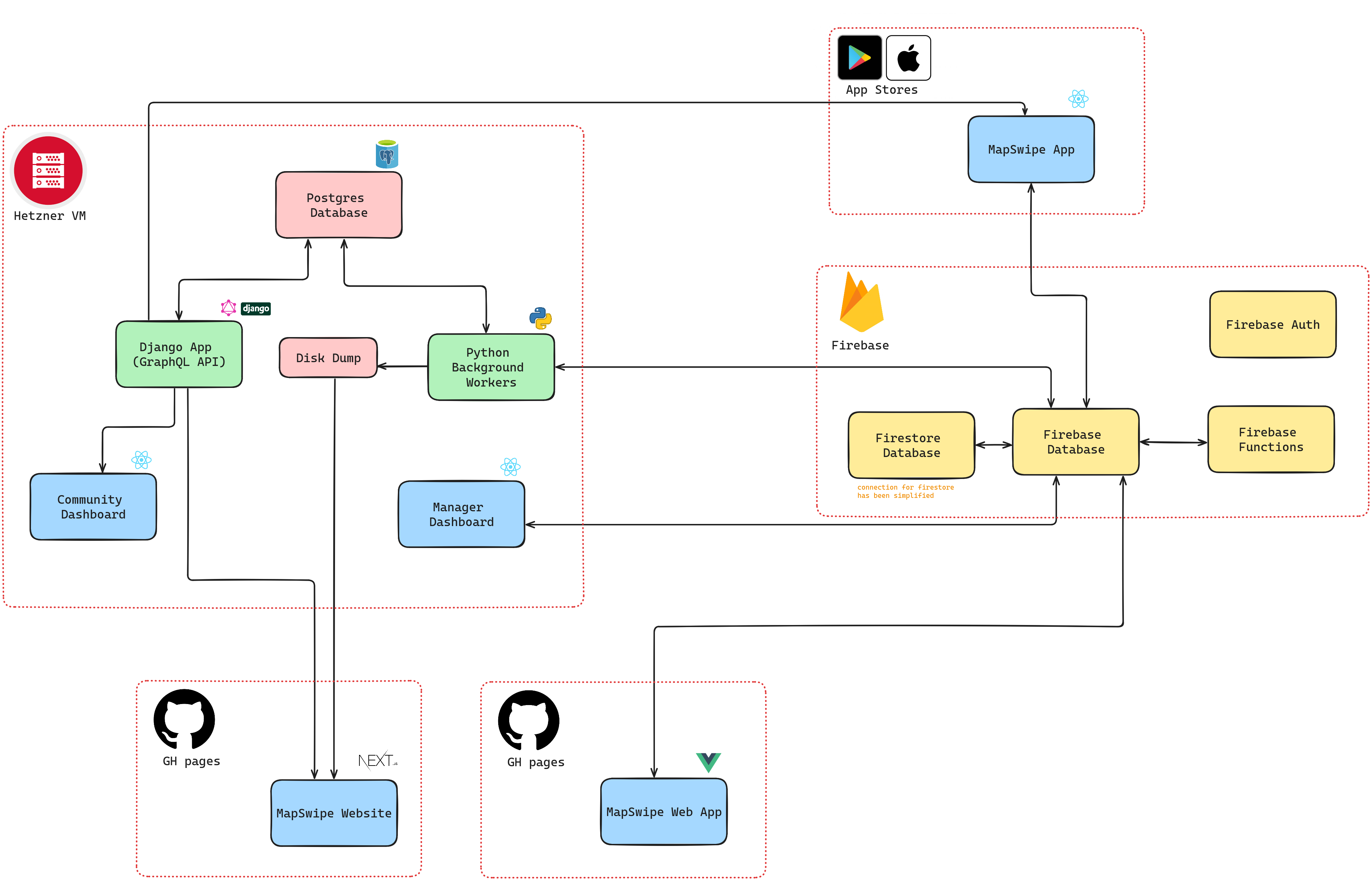
The legacy system had two different databases:
- Firebase — the primary database. It interfaced directly with the Manager Dashboard, Mobile App, and Web App, and stored users, user groups, draft projects, active projects (with tasks), user contributions, and user swipe results (temporarily).
- Postgres — the secondary, long-term database. It stored users, user groups, draft projects, all projects (with tasks), and all user swipe results.
The primary reason for keeping Firebase as the primary database was auto-scaling in case of a large number of submissions, typically during MapSwipe mapping events. A background worker periodically synchronized (partially) the two databases.
New architecture
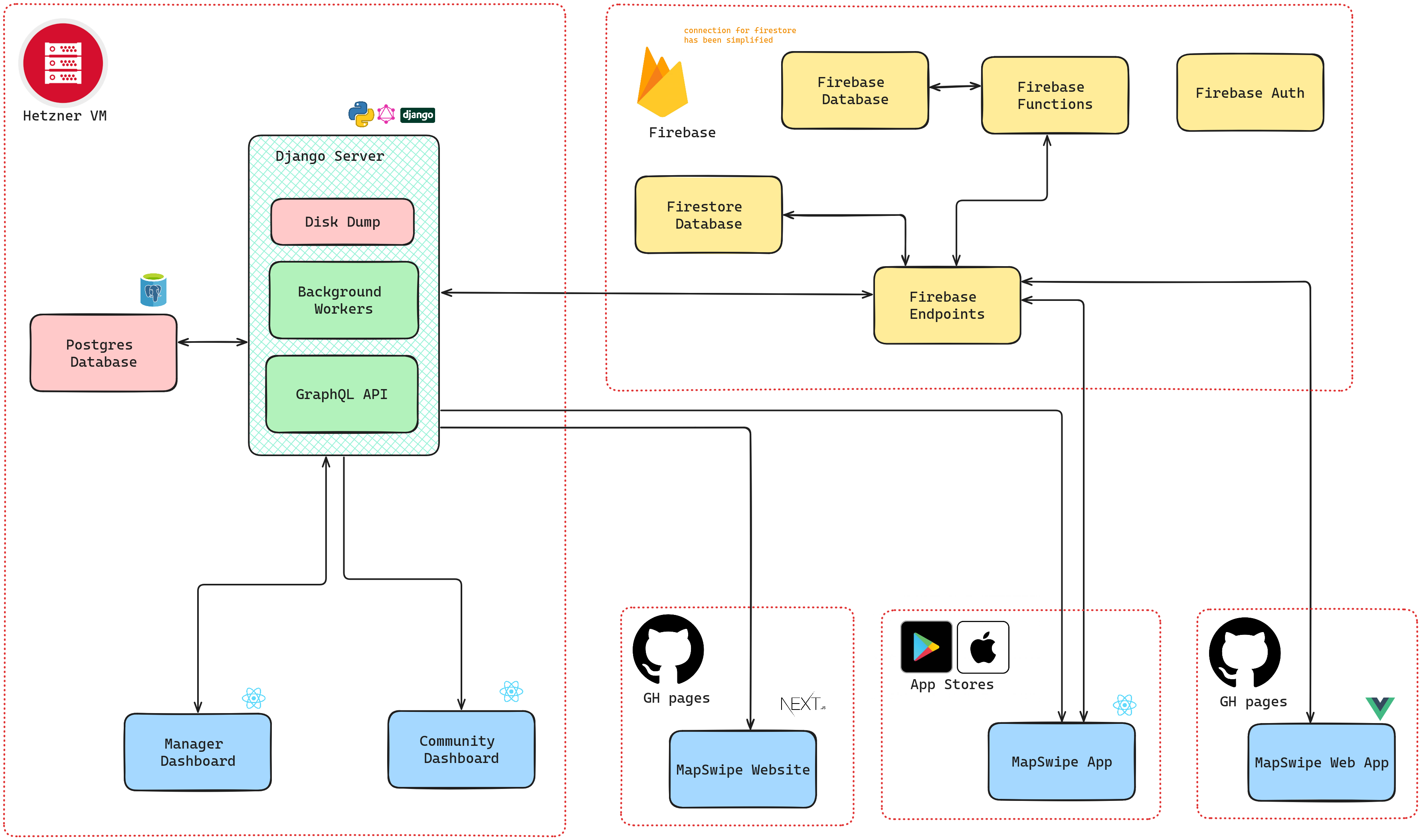
The major difference in the new architecture is that Postgres is the primary database. Only the MapSwipe mobile and web apps interface with Firebase directly. The system stays scalable and reliable while significantly reducing the usage of the Firebase Realtime Database. See the Components section below for an inventory of the pieces.
Note
Firebase Endpoints shown in the new architecture diagram is planned for a future iteration and has not yet been implemented. Today, the mobile and web apps still read from and write to the Firebase Realtime Database directly.
Components
Public Website
- Source:
mapswipe/website - Deployed at: https://mapswipe.org/
The public-facing website for MapSwipe — an introduction to the project, recent mapping work, the organisations behind it, and links to the apps and dashboards.
Mobile App
- Source:
mapswipe/mapswipe - Deployed at:
- Android — Google Play Store
- iOS — App Store
The contributor-facing app where users swipe to complete tasks. Reads project, group, and task data from Firebase Realtime Database; writes submitted results back to Firebase, which are then synced to the backend.
Manager Dashboard
- Source:
mapswipe/manager-dashboard - Deployed at: https://managers.mapswipe.org/
The web application project managers use to create and manage projects, tutorials, organisations, managers, contributors, user groups, and teams. Talks to the MapSwipe backend via GraphQL. See For Project Managers for the user-facing documentation.
Community Dashboard
- Source:
mapswipe/community-dashboard - Deployed at: https://community.mapswipe.org/
A React-based static site showcasing aggregated MapSwipe contribution stats, plus profile pages for users, user groups, and organisations. Reads cached aggregated data from the backend.
Backend
- Source:
mapswipe/mapswipe-backend
The central Django server backed by Postgres. A single service is responsible for:
- The GraphQL API consumed by the Manager Dashboard and the Community Dashboard.
- Data synchronisation between Postgres and Firebase Realtime Database — including the background workers that transfer in-flight results out of Firebase and into Postgres for long-term storage.
- The data-export generation that produces the files documented under About the Data.
Firebase Cloud Functions
- Source:
mapswipe/mapswipe-firebase
Cloud Functions that react to Firebase Realtime Database events — incrementing per-user contribution counters when results arrive, propagating user-group membership changes, queuing PSQL-sync flags so the backend knows what changed, and serving the OSM OAuth login.
The functions co-exist with the runtime Firebase Realtime Database, which holds active project / group / task data and in-flight result submissions until the backend workers transfer them to Postgres database.